
Sustainability is engineering — measured, bounded and honest about trade-offs.
No slogans. Every figure we publish carries its status, scope and baseline — and we say plainly what controlled growing costs, as well as what it saves.
less water
The aeroponic root environment delivers water and nutrition directly to the root zone and recirculates what plants do not take up.
The figure is relative to open-field farming of comparable crops; methodology and baseline are documented and available in qualified materials. It is a bounded engineering claim — not a slogan.
power-unit efficiency
Our planar LED luminaires are engineered in-house; 92% is the efficiency of their planar power units — the lighting power electronics specifically. It is a component figure: not the whole facility, and not, by itself, evidence of lower energy use per kilogram.
The honest trade-off: controlled growing uses electricity. The engineering answer is efficiency per kilogram of berries — light placed close to the canopy, insulated chambers, climate recovery — and siting farms where energy economics support the model.
not continents
Farms are built close to the people who eat the berries: shorter transport routes and reduced reliance on long-distance cold chains.
We do not publish a total carbon figure until a full life-cycle assessment supports one. Proximity is stated as what it is — shorter routes and fresher fruit, not an unbounded climate claim.
product waste, as a pathway
Zero Waste is the company’s approved strategic direction, with a defined system boundary: surplus berries are freeze-dried into shelf-stable premium products rather than discarded.
We describe this as a pathway to near-zero product waste — the system boundary is the berry itself, and the claim grows only as the evidence does.
Biology is part of the engineering.
Honey bees live, pollinate the crop and make honey inside the growing chambers. Honey bees inside the growing chambers are a visible sign of a biologically functioning growing environment.
Living pollinators are a visible sign of a biologically functioning growing environment. They are not evidence of pesticide absence; such claims require production protocols and laboratory results.
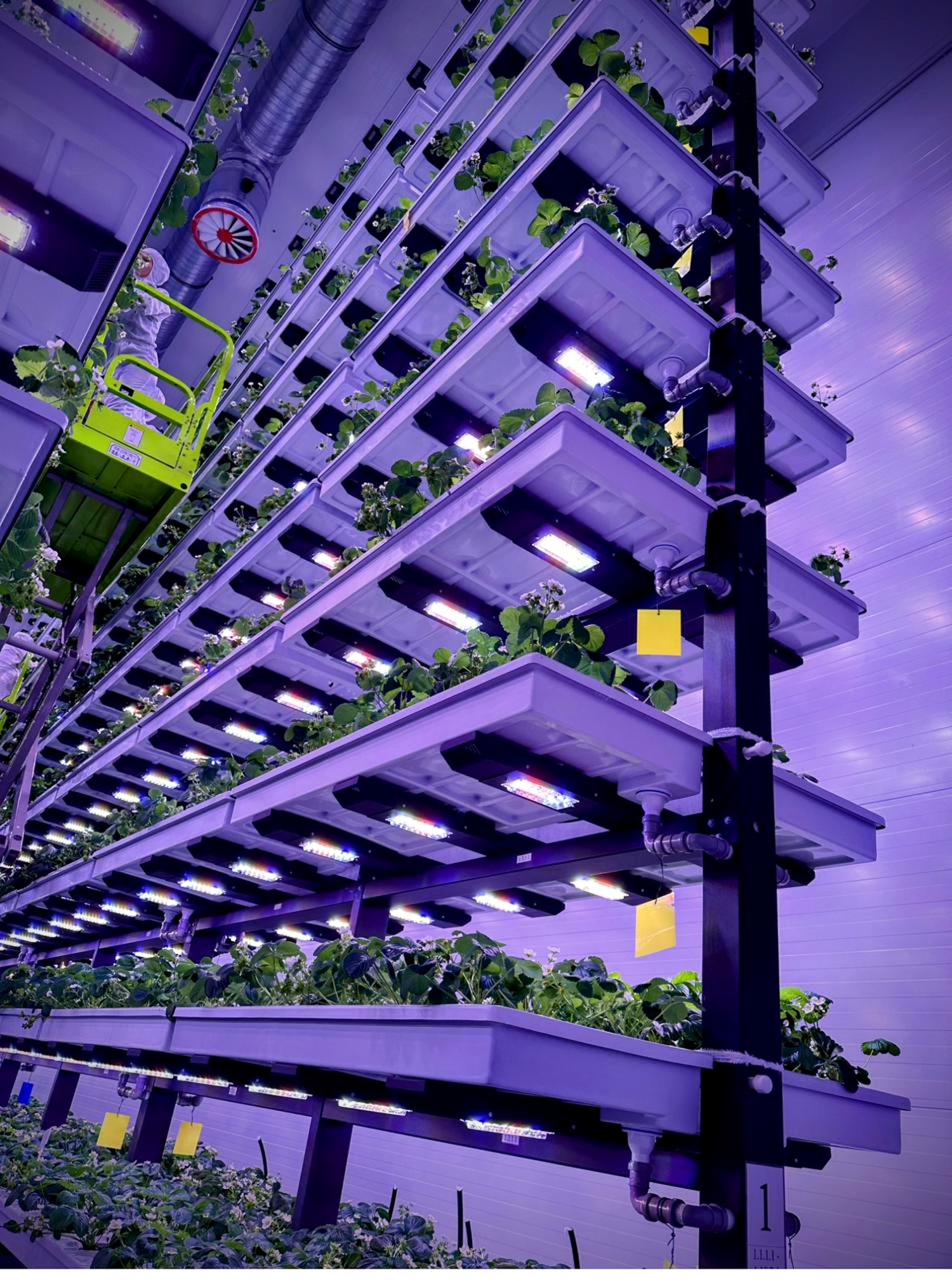
What controlled growing costs — and what it buys.
Energy, capital, discipline
Chambers use electricity; facilities take capital and exacting operations. We do not pretend otherwise — these costs are engineered down, market by market, and priced into the model from the start.
Water, proximity, flavour
Up to 95% less water than open-field growing through closed-loop aeroponics, less dependence on long-distance cold chains, and a berry harvested at peak ripeness — available the same day, year-round.